Mountain Hunting
How Many Days Per Week Should Hunters Train with Their Packs?
You don’t want to be unprepared, right? That’s why the subject of this article grabbed your attention. It’s unpleasant to picture yourself lugging a heavy pack through the backcountry while it steals the gusto from your legs and thrashes your back. Not to mention being the last guy up the hill, breathing hard enough to start a hurricane. None of it is good.
Then, you search, “how many days per week should a hunter train with their pack?” And you hope to find information that gives you clarity and puts your mind at ease. I’ll offer you clarity. But doing the work and knowing you’ve done it is the only way to truly ease your mind.
Pack training for hunters is nuanced. There’s no “just do this many days” answer. How many days per week you should train with your pack depends on a handful of factors. Let’s break them down and get you answer to your question.
Getting Efficient Under Your Hunting Pack
Before the big hills and the meat hauls, you must get efficient under load. That means you can move at a good clip under your pack without it costing you too much energy. It has to come first, otherwise you won’t have the necessary base for packing up and down hills. There are a few contributing fitness components. And then there’s your pack itself. We’ll start with your pack.
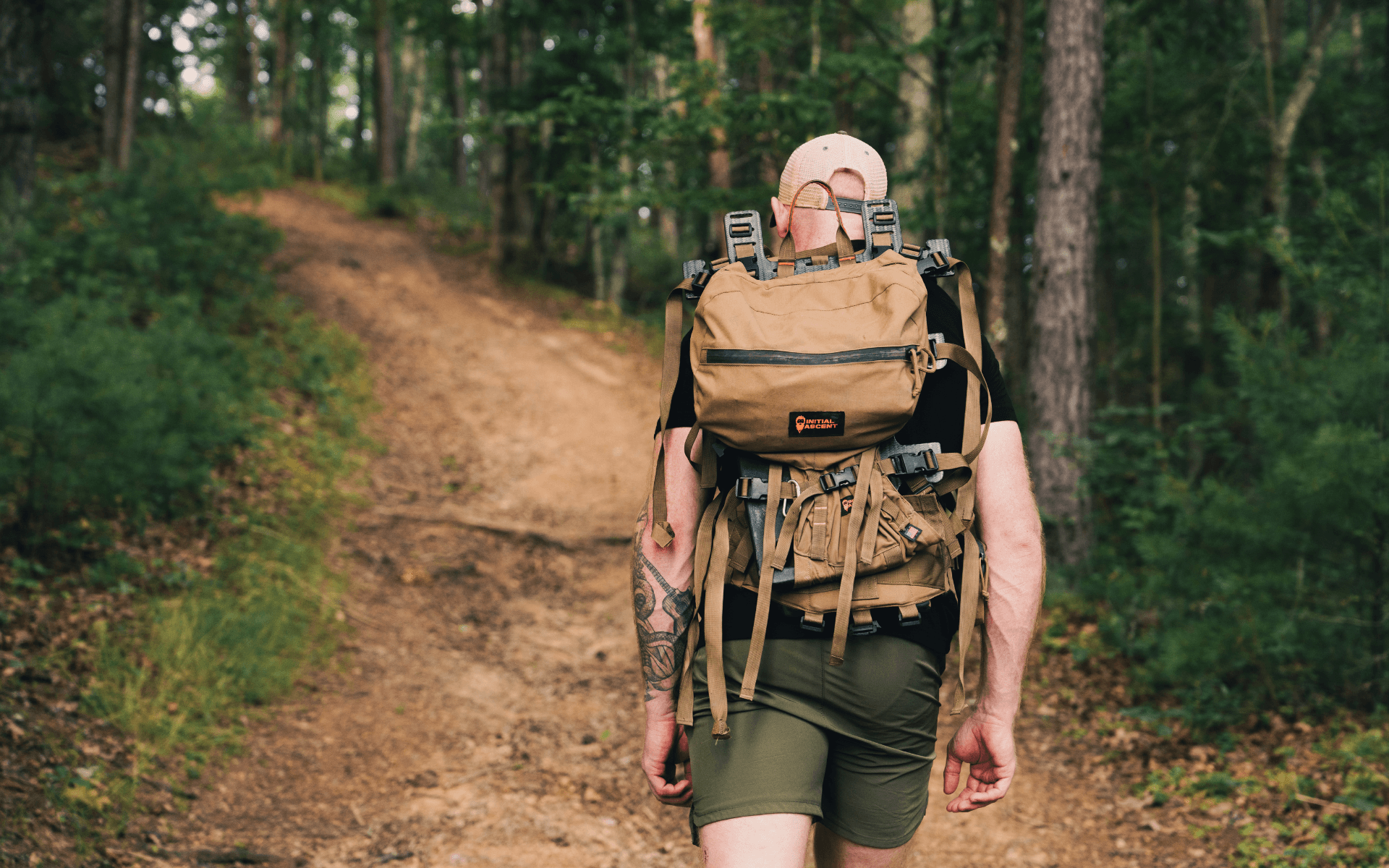
A lot of hunters don’t properly load their packs, while training and while hunting. They follow old school advice that says put all the weight at the top. Or they load the weight too low and too far away from their back. Neither is good for rucking ergonomics. You want the weight in the middle of your back and as tight to your spine as possible. This weight distribution keeps you as upright as possible while keeping stress off of your shoulders, back, and hips. It keeps your back from hurting, and it keeps you from waddling around like Donald Duck. Also, it makes lateral and rotational movement easier. There are very few straight lines in the mountains. You will inevitably dodge, dip, duck, dive, and…dodge. (Name that movie.) On top of keeping stress off of your joints and making movement easier, keeping the weight in the middle of your back and tight to your spine makes breathing easier. Poor breathing under load will fag you out fast.
Then come the fitness components.
Rucking, Man. You Gotta Ruck
The first, of course, is training with your pack on. If you want to get good at something, you have to do it. Efficiency is built through volume. That means you have to ruck frequently, and sometimes for long workouts, to build efficiency. (We’ll talk about how frequently in just a minute.) But it doesn’t help to just load that sucker up and take off. It’s important to use the right amount of weight.
When building efficiency under load, you have to use a weight that makes all of the circles touch. It must be heavy enough to challenge your posture and gait. But it can’t be so heavy that it dramatically changes them. Remember, efficiency also requires volume. So, it must be light enough for you to handle a fair amount of rucking. Those are our circles. They touch around 20% of body weight. It’s heavy enough to challenge your posture, gait, and breathing while reinforcing good mechanics, but not so heavy that it beats the hell out of you.
The 20% of body weight prescription is for a hunter who’s in reasonably good shape and has done a little rucking. If you’re new to rucking, aren’t in great shape, or are overweight, you need to start lighter, around 10% to 15% of body weight and work up to 20%.
Now, we answer the question, how much volume/frequency to build efficiency? You’re looking at 1-3 flat ground sessions of 30- to 60-minutes per week. All of the sessions should be at a pace that’s just north of comfortable when you first start out. If you’re brand new to pack training, start with a single 30- to 45-minute session. Do that for a couple weeks, then add a second session. As you start to improve, you can progress by doing two sessions lasting 45- to 60-minutes at just north of comfortable, and one very brisk 30-minute session. (But no running. Running with your ruck on is a recipe for a joint or bone injury.)
Eventually, it’s necessary to do sessions longer than an hour and up to two hours or more in some cases. If you’re consistent with the above schedule, you’ll get to 90-minute sessions within the first few months.
Strength Training
Improving relative strength improves efficiency under load. It’s a big reason why strength training is so important for hunters. As you get stronger relative to your body weight, each step you take costs you less energy because you have to recruit less muscle to take that step. You use fewer resources to do the same job.
It also aids with maintaining posture and staying resilient under your pack. Strength training with good form and in good positions can improve posture. It improves your ability to manage tension in your body and makes your joints more resilient so your pack doesn’t beat you like an angry pimp.
Mobility Training
Efficiency requires good movement. If your ankle mobility sucks, your gait will suck. You’ll swing your leg more to the side with each step to compensate. That wears you out when you’re taking a lot of steps. If your hip mobility lacks luster, you’ll often “duck” your feet out, causing a similar issue. Walking costs more than it should by itself, and you’re adding a weighted pack to the party.
Like, strength training, mobility training helps improve your posture. Getting your shoulders into a better position helps you bear the tension of your shoulder straps. A spine that moves well helps keep you upright as you march forward. Each contributes to less stress from your pack and better breathing. Each contributes to efficiency and endurance.
General Aerobic Fitness
Your aerobic system is your endurance and your recovery system. If you want to produce energy for longer, and at lower cost, it’s the ticket. Most rucking, especially on flat ground, is aerobic. However, general aerobic work, such as biking, jogging, and hiking, is better for overall aerobic fitness. There’s less muscular load, so you can handle more volume and you can move faster. This improves the rate at which your aerobic system produces energy. Those modes of training don’t restrict your breathing like rucking does, giving your heart and lungs a greater training effect. Keeping up with a solid amount of general aerobic training year-round builds the raw materials that improve your rucking and allows you to handle more of it.
How to Know You're Efficient Under Your Hunting Pack
The best way to know is by testing it. Back in 2018, I developed the 3-Mile Rucking Assessment to test hunters’ basic efficiency under load. Since then, I’ve used it to test hundreds of hunters, gen pop training clients, special operators, and first responders. It’s a valid measure for determining if you’re generally efficient under your pack.
If you can ruck 3 miles on flat ground in 45 minutes or less with 20% of your body weight in your pack while maintaining an average heart rate in Zone 2, you have base efficiency under load.
You can learn more about the 3-Mile Rucking Assessment by reading THIS article.
Keep in mind, it may take months to reach this level of efficiency, especially if you’re starting with zero rucking experience and if you’re lacking strength or aerobic capacity.
Pack Training Frequency Depends on Fitness Level and the Types of Workouts
Different pack workouts come with different costs. For example, a 180-pound hunter will burn about 540 calories during a 60-minute ruck on flat ground with 25% of his body weight, moving at a 4 mile-per-hour pace. That same hunter will burn about 775 calories on a 90-minute ruck with 20% of his body weight moving at the same pace. Add in an incline or undulating terrain and the cost exponentially rises. We have to be aware of the costs of each kind of rucking workout when considering pack training frequency.
I used calorie expenditure for illustration’s sake and so you could see some math with different loads. But the cost extends beyond the amount of calories burned. We also have to consider muscle damage and nervous system fatigue. Bearing weight and moving for extended periods stresses all of your bodily systems. Give your body too much stress too frequently and your rucking fitness will tank as you walk yourself into an injury.
Fitness level and pack training experience are each big factors in how well someone manages rucking frequency and the different types of pack workouts. But the combination lives on a bell curve. You can walk yourself into too much pack training, especially if you’re strength training and doing other conditioning alongside your rucking.
Rucking Frequency Based on Fitness Level and Pack Training Experience
Fitter folks can handle more, but at times need less. They can manage, and often benefit from, a couple 90-minute terrain rucks per week. They have the efficiency under load, resilience, and aerobic capacity to do it. And those longer rucks can help to solidify all of that while improving their hunting fitness. However, once you’re that good at rucking, you don’t need as much of it to keep what you have. For example, researchers found that a single long rucking session every 10 to 14 days is enough for experienced military ruckers. But we have to keep in mind that this doesn’t account for specific mountain or backcountry hunting prep. Even those experienced with pack training need more and different types of rucking depending on the proximity to hunting season. We’ll talk about that more in a minute. But in general, hunters who are good at rucking likely only need one session per week to keep what they have, especially if they are strength training and doing other types of aerobic conditioning.
It’s a bit more nuanced for those who aren’t as experienced or in as good of condition. These hunters often use rucking as their main conditioning method, and they need to build efficiency. So, they follow something like the protocol listed above. The big factors for them are duration and intensity. They don’t have the capacity for long sessions. They don’t have the power or resilience for hard sessions. Doing 2 or 3, 60-minute or less rucks per week builds the capacity and resilience necessary for longer and harder sessions. Each is necessary for solid hunting preparation. It takes consistent volume over time to get there. You have to give yourself enough time.
Rucking Frequency Based on Types of Pack Workouts
Long (90 minutes or more), moderately-heavy (~20% of body weight) terrain rucks have the biggest cost. Depending on the time of year and training phase, you only need one to four of these sessions per month. Do more than that and the Bad News Bears are coming your way to give you an injury or overwhelming fatigue.
Short (45 minutes or less), heavy (~30% of body weight) uphill rucks designed to build muscular endurance can be done more frequently. During the early preseason, we’ll do these types of workouts four to eight times per month, depending on a hunter’s fitness level.
Extremely heavy ruck (~35% to 50% of body weight) training must be used sparingly. We only do about four of these sessions total (one per week), right in the middle of preseason training. They’re designed to acclimate to heavier packs for heavy pack outs and build fast-twitch muscular endurance in the legs. We use a method called High-Intensity Continuous Training (HICT), and apply it to box step-ups on a 12-inch box. This keeps the training environment relatively safe and controlled while managing such a heavy pack load.
Rucking Frequency Based on Training Block/Phase and Proximity to Hunting Season
We’ve mostly discussed pack training in general up to this point. But it’s important that we frame it within the context of hunting prep. It’s a layered process that requires us to use rucking in different ways throughout the training year. Those different applications lead to different rucking frequencies.
Proximity to hunting season also plays a role. We use rucking in January differently than we use it in June, and differently than we use it in October. This influences how often we train with our packs.
A training block lasts from six weeks to three months. A training phase lasts three or four weeks. They are units of time used to organize training based on the end goal. Each phase has a set of subgoals that contribute to the main goals of the training block. Our training block sequence with the associated goals are listed below:
Early Offseason (Jan - March): General Aerobic Capacity + Strength
Late Offseason (April - May): Specific Aerobic Capacity + General Strength Endurance
Preseason (June - Aug/Sep): Specific Uphill/Downhill Conditioning + Specific Muscular
Endurance + Specific Strength Endurance
Inseason: (Sep/Oct - Dec): Strength + Conditioning Maintenance
We don’t ruck much in the early part of the Early Offseason block. But as we get past the halfway point, we start doing light to moderate weight rucks once per week.
The Late Offseason block introduces more pack training. We ruck two times per week with light to moderate loads to convert our general aerobic capacity into specific aerobic capacity for backcountry and mountain hunting. We also do a few weeks of HICT step-ups with moderate loads.
We do a lot of rucking from the beginning through the middle of the Preseason. We’ll do short uphill muscular endurance sessions 1-2 times per week with heavy loads. We bring back HICT for short sessions with extremely heavy loads before transitioning to longer HICT sessions with heavy loads. And we’ll do long, light rucks on the weekends.
Rucking frequency tapers in the later phases of the Preseason. We’ve built the raw materials we need. It’s then time to back off the stress so we aren’t beat to shit when hunting season starts. We’ll do 1-2 sessions per week, depending on the duration and the weight carried.
While in season, we ruck once every one to two weeks depending on our hunting schedules. We just need to maintain what we have to stay ready for hunting.
How Many Pack Training Days per Week?
Now you know why the answer isn’t a simple, just do this much. Your fitness, your pack training experience, and training goals depending on the time of year all contribute to how many pack training days you do per week. And it all starts with training to be efficient under your pack.