Testing and Assessments
How Hunters Should Test Their Mobility
The following is an excerpt from the upcoming The Hunter's Guide to Uphill and Downhill Training. I'll be releasing more excerpts in the coming weeks and opening up registration for a pre-sale list with sweet bonuses.
Mobility, a.k.a. movement capacity, is misunderstood and under trained in the hunting fitness world. Good movement begins with understanding your current mobility needs. You have to test to get a handle on your current needs. Otherwise, you're firing blanks into the dark.
Here's a rundown to how we approach movement testing straight from the book.
Movement Capacity Tests
Our movement capacity testing has two goals. The first is to determine if a hunter has mobility gaps that should be addressed to improve their movement efficiency. The second is to ensure they’re doing the right strength exercises in the weight room. If joints don’t move well enough for a particular exercise, loading those joints while doing that exercise is what we Americans call “a bad idea.” We’ll discuss each weight room scenario as it pertains to each test.
Our movement capacity tests cover the joints that require the greatest degrees of freedom — aka the most range of motion — and that have the greatest impact on your performance as a human being and a hunter. They are the shoulders, the hips, and the ankles. At the end of this section I’ve included a link to a YouTube video that demonstrates the Movement Capacity Screen. Below, I’ve written out the test descriptions and why they matter. But I’ve saved full descriptions and demonstrations for the video.
Shoulder Mobility Tests
Chances are, you think of your shoulders as the ball-and-socket joints that move when you lift and/or rotate your arms. But the ball-and-socket part of the shoulder (it’s called the glenohumeral joint) is only one of four joints that comprise the shoulder complex. We’re gonna get a little nerdy for your edification. Here are the four shoulder joints and their functions:
Glenohumeral joint (GH): It creates the major range of motion at the shoulders.
Scapulothoracic joint (ST): It’s where your shoulder blade attaches to your rib cage. It helps to stabilize and create movement with your glenohumeral joint.
Acromioclavicular joint (AC): It helps to maintain the position of your scapula while also assisting in fine tuning shoulder movement.
Sternoclavicular joint (SC): This is where your collar bone attaches to your sternum. It attaches the rest of your shoulder girdle to your body to provide stability and support.
We need all of these joints to function well and with the right timing to have healthy shoulders without movement limitations. However, a lot of folks have movement limitations at the glenohumeral and scapulothoracic joints. This happens for all sorts of reasons. Sometimes it’s because of limited upper-back mobility that negatively affects how the scapula rests on the rib cage and moves. Sometimes it’s because of stiffness or weakness in the muscles and connective tissues of the joints. It’s not necessarily our job to sort all of that out. That’s why we have rehab professionals like good physical therapists and movement-based chiropractors. However, the base understanding is helpful.
Our tests are designed to tease out basic, big movement functions of the shoulders, mostly at the glenohumeral joint and the scapulothoracic joint and how they interact with each other and the rib cage. The first is the Shoulder Mobility Screen borrowed from the Functional Movement Screen, or FMS.
Shoulder Mobility Screen
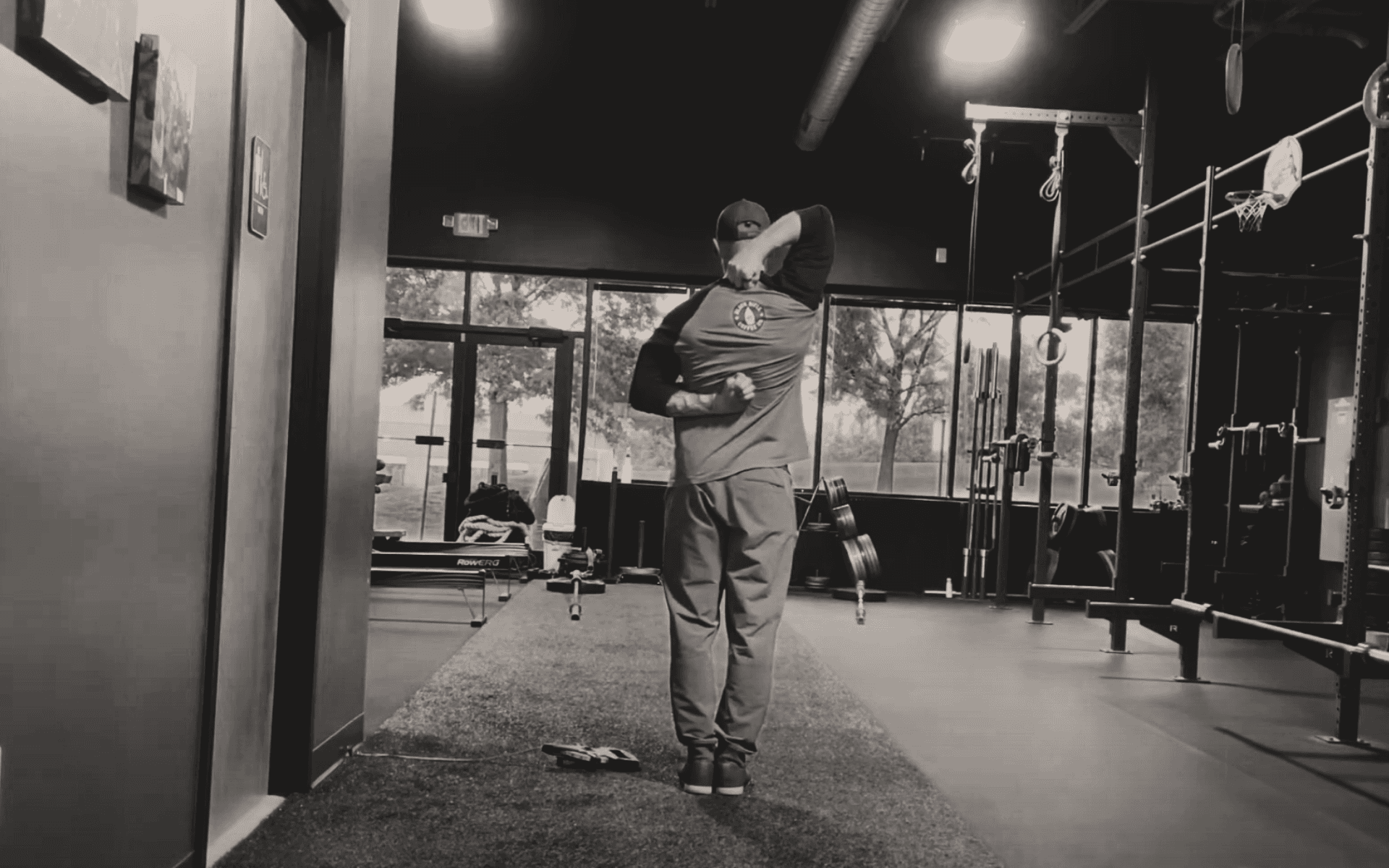
The Shoulder Mobility Screen tests the interactions between your GH joint, your ST joint, and your rib cage. It has you get your fists as close as possible behind your back by taking one arm behind your head and the other up the small of your back. These motions challenge the full range of motion of each shoulder in opposite directions. We learn how well each shoulder rotates and if they move relatively symmetrically.
You pass the screen when you can get each fist within 1.5 handlengths behind your back and your movement in each direction is within a few inches of each other. For example, let’s say that your hand is 7 inches from the first crease in your wrist to the tip of your longest finger. One and a half times that is 10.5 inches. So, if your fists are 10.5 inches apart with your right arm behind your head and 9.5 inches apart with your left arm behind your head, you pass. If it’s a crazy gap such as they are almost touching with one arm behind your head and there’s a 7-inch space between fists with the other arm behind your head, the asymmetry is too big. And if the space between fists is bigger than 10.5 inches when you move in each direction, it’s a failure.
Now, if you pass the Shoulder Mobility Screen, you’re good to do any overhead work (if you also pass the straight arm raise we’ll cover later). If you don’t pass, you should avoid overhead pressing and, likely, most overhead pulling (chin-ups, pull-ups, lat pulldowns). The good news is shoulder mobility is relatively easy to improve. So, if your shoulder mobility is shit now, you can make big strides in a hurry by diligently and consistently doing movement capacity exercises to improve it.
The drawback of the Shoulder Mobility Screen is you need someone to measure the distance between your fists when you do it. If you don’t have anyone to give you a hand, you can use the next test as a passable substitute.
Apley’s Scratch Test
Instead of moving both arms at the same time, you’ll move one arm at a time. You’ll reach your arm behind your head, attempting to touch the top of the opposite shoulder blade. And then you’ll reach behind your back, attempting to touch the bottom of your opposite shoulder blade. This tests a similar range of motion as the Shoulder Mobility Screen. If you can do all the touching you’re trying to do, you’re good to party with overhead work — again, provided that you also pass the straight arm raise.
Straight Arm Raise
The straight arm raise is exactly what it sounds like. You keep your arms straight and raise them in front of you as far as you can, the goal being to get them parallel with your ears without your rib cage moving. This tells us if you can get your arms overhead without compensating by taking range of motion from your lower back. If you have to arch and push your rib cage out to get your arms up, you’re either lacking mobility in your upper-back, in your ST joints, or in your GH joints. More tests would be necessary to determine exactly what’s going on, but they are beyond our scope. That’s a job for a movement rehab pro. Just know that it would be a do not pass go, do not collect 200 dollars situation. And that means no overhead work. Again, that’s not a lifelong sentence. You can improve on this test with consistent movement capacity training.
With shoulder mobility testing covered, let’s move on to hip mobility testing.
Hip Mobility Tests
As Chubs so generously taught us in Happy Gilmore, it’s all in the hips, baby. The hips are second only to the shoulders in available range of motion. We need as much of that range as possible if we plan to get the most out of our bodies as humans and as hunters. We use three simple tests to assess hip mobility, starting with the Active Straight Leg Raise. These tell us which lower-body exercises are appropriate, as well as whether or not a hunter needs to work on hip mobility for health and efficiency’s sake.
Active Straight Leg Raise
The Active Straight Leg Raise evaluates how well you move at one hip while maintaining core control and stability in the other hip. This is important because most of what we do happens on one leg while the core maintains stability. Think about walking. One leg swings while the other plants and the core fights rotation to keep you from twisting all over the damn place. We also need to see how well one of your hips flexes (on the leg that’s being raised) while the other maintains extension (the leg that remains on the ground). This all tells us a lot about the general state of your hips. And, as Shakira said, the hips don’t lie. (I really tried to talk myself out of making that reference and I couldn’t. So, here we are.)
To pass the test on both sides, you must keep both legs straight and neither must rotate. The raised leg must travel high enough that your ankle gets at least even with your knee. This tells us that your hips have the raw materials of adequate mobility and stability. If you can’t get your knee that high on both sides, you don’t pass. That means your hips need some mobility and stability work. It also means that you should limit your deadlift range of motion to the knees and higher, and that you should do top down deadlift variations like RDLs instead of bottom up deadlift variations such as rack pulls and hex bar deadlifts.
Standing Toe Touch
I have a hunch so strong I’m willing to bet a grand on it. I’d bet that you’ve gone your whole life thinking that touching your toes is just about having flexible hamstrings. You don’t have to tell me that I won my bet, I’m sure of it. Here’s the deal, your hamstrings are only one part of the toe touch equation, and that’s not what we’re mostly testing.
Before I get deeper into this, I will offer you some gratification. Yes, tissue extensibility (the fancy term for flexibility) of the posterior chain is part of the deal. We’re looking at how well the muscles of your back, hamstrings, and calves stretch. But the test is much more about how well you coordinate movement between your core and your hips. Can you fold yourself in half while pushing your hips backwards? That’s the main question being answered. Also, just because your hamstrings feel tight when you try to touch your toes doesn’t mean that they are. It likely has nothing to do with the tissues of your hamstrings and is the result of poor coordination between your core and hips. So, your brain says, sorry, no-can-do and puts the brakes on. It makes your hamstrings feel tight, but really they’re just stopping you from falling on your face. This is all to say, what we’re really learning from the standing toe touch is whether or not your hips and core automatically work well together for you to effectively hinge. If they don’t, you likely need some core work, hip mobility work, and some patterning exercises to teach you better hinging. As it goes with the Active Straight Leg Raise, so it goes with the standing toe touch — if you can’t touch your toes, limit your deadlift range of motion to the knee or above until your toe touch improves.
Seated Toe Touch
Now, the seated toe touch is done mostly to assess the flexibility of your hamstrings and low-back, as well as spinal mobility. It’s a good pairing with the standing toe touch because it offers another data point between flexibility vs core and hip control/mobility. If you can touch your toes while seated on the floor, but you can’t while standing, your flexibility is fine. You have a hip and core coordination issue, or a hip mobility issue.
Ankle Mobility Test
We only use one ankle mobility test because, well, we only need one. The most important aspect of ankle mobility to test is dorsiflexion. That’s the act of bringing the top of your foot closer to your shin. It’s the most important to test because it’s the aspect of ankle mobility that most people lack. Much of the reason is postural. We often stand with our weight shifted forward, so our calves are literally keeping us from falling on our face. The increased neural drive to prevent that tumble and consequential visit to the dentist, tightens them. Some folks also just have poor mobility for a plethora of other reasons. One other reason is jamming your feet into stiff boots and shoes all the time. This weakens the feet and limits the range of motion the ankles naturally move through. No matter the reason, we need our ankle dorsiflexion to be as good as we can possibly make it for efficient movement. Otherwise, we end up with odd gait (walking) patterns that steal our energy — especially on uphill climbs. Good dorsiflexion promotes good knee lift which promotes better uphill marching. This saves you a lot of energy.
The wall ankle mobility test is what we use. It’s easy to perform and it gives all of the information that we need. It’s done in the one-half kneeling position (one knee up and one knee down) and by gliding forward until your up knee tracks over the middle of your foot and touches the wall. You have solid ankle mobility when you can touch your knee to the wall while tracking your knee over the middle of your foot while keeping your heel on the floor.
It’s not the end of the world if you can’t touch the wall with your knee while your toes are five inches away. But it does mean that you need to persistently work on your ankle mobility. If you’re three inches or less from the wall, it’s a good idea to elevate your heels during squats. This compensates for the lack of dorsiflexion while also putting your pelvis in a better position.
Here’s something you need to know about ankle mobility — it’s tough to improve. It takes a lot of effort over an extended period to make strides. So, you must keep at it.
The Movement Capacity Screen
You need some visuals. Let’s provide those. As I mentioned at the beginning of the Movement Capacity testing section, I have a YouTube link for you to watch me perform and coach you through all of the movement capacity assessments. Friend, here’s that link:
——-
If you'd like to test more than your mobility right now, and get a full scope of your current level of hunting fitness, download The Hunter's Field Test at the link below. You'll test your strength, mobility, and conditioning so you know where your hunting fitness stands right now.
Click >>> The Hunter's Field Test