

PackMule
In-Season Hunting Fitness: Using Unilateral Strength to Stay Healthy and Build Muscle
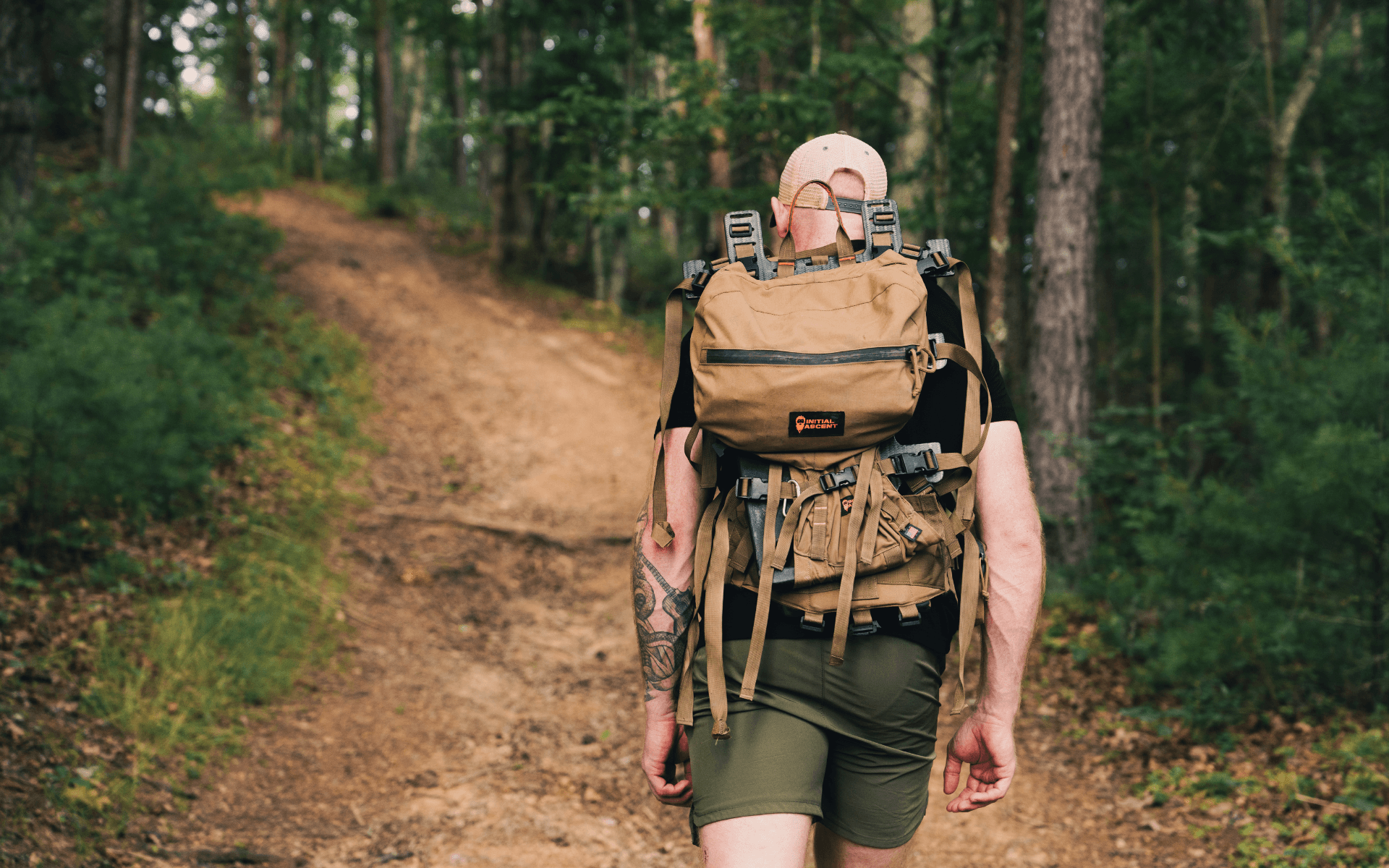
You roll over on your sleeping pad, sit up, and slide on your sox. It’s a chilly son of a bitch of a morning; it makes you think you were a fool to have slept barefoot. You crawl over to the tent flap and unzip it. Kneeling on one knee, you put on one boot and tie it, then the other. Driving off that leg, you stand up tall. Time to get water.
It’s a steep hill that leads down to the creek; you sideways walk down it to keep from going ass-over-tin-cups into the water. After you fill up the containers, you march back up the hill to camp, one driving step at a time. Then it’s coffee and a quick freeze-dried breakfast. After that, it’s time to move. You grab your day pack with one hand and sling it over your shoulders. The march to your glassing knob begins.
On the way up, you step over logs as you move through dark timber, you post your hand on a boulder as you swing your body onto a boulder another boulder. Finally, you reach the knob and you settle in for a few hours glassing.
This is a relatable scenario, right? Sounds like a normal morning on a big game hunt. Review all of the described movements – they’re all unilateral, using one limb at a time. Go ahead and try to move through your day always using both of your legs and both of your arms at the same time. You’d look like some kind of weird ass Muppets character hopping around the woods. And you’d wear yourself right out.
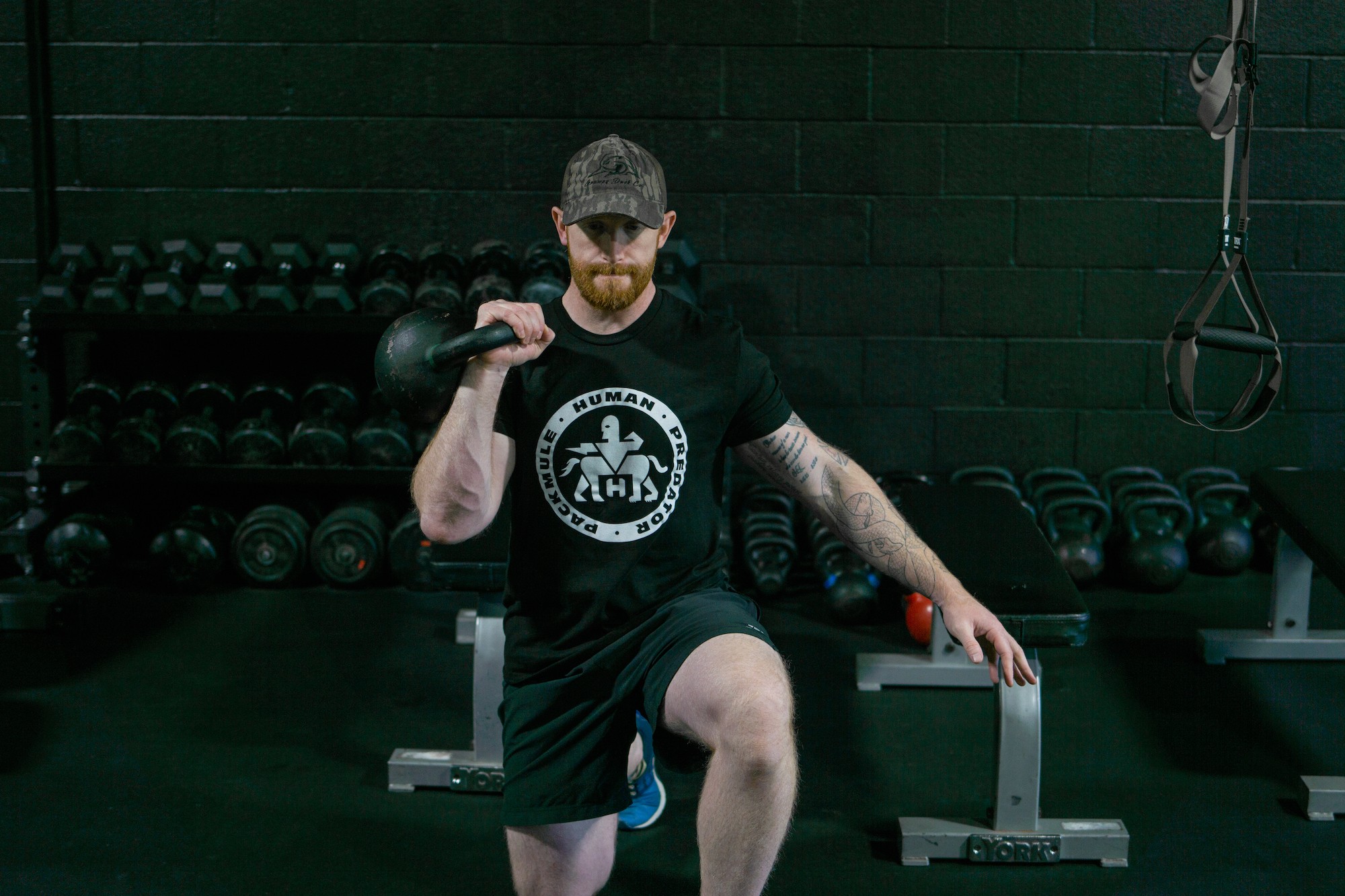
Most of what we do in the backcountry requires joint mobility, strength, and stability on one limb. That’s why our early in-season strength training focuses on unilateral strength training.
In-season Unilateral Training: Why to do it and What it Gives You
Unilateral strength training in-season does a few things for us. It helps clear up strength imbalances from left to right, trains us to gain and maintain joint range of motion under load, and trains us to have balance and stability during force production (strength). And, after a summer filled with conditioning, it offers a low-cost way to increase strength volume to gain muscle.
Balancing strength on each side of the body (as well as it can be balanced) keeps joints and tissues healthier because stress gets evenly distributed – or at least has the opportunity to be evenly distributed. Overuse injuries come from disproportionate tissue loading. For example, injuring your right shoulder because you draw your bow 5,000 times per year. Unilateral strength training can help protect the tissues of your draw shoulder, as well as motivate you to use your left arm more for other tasks because it feels stronger.
Unilateral training also often takes us to joint ranges of motion we don’t experience with bilateral (two limb) training. Loading a bigger joint range of motion makes it easier for your body to keep that range of motion. Your brain and body recognize your ability generate force from that position, and your muscles, tendons, and ligaments strengthen. This is all cause for you to improve and maintain access to more joint range of motion. We like this.
Balance is hugely important for longevity, and good balance is a positive indicator of healthy nervous and musculoskeletal systems. And it’s real dang handy for walking over boulders and blow downs. Maintaining balance while accessing strength allows you to do more in the backcountry. Folks with poor force production from awkward positions are held back in a lot of scenarios. But if you’re strong, you won’t be held back.
Then there’s muscle mass. Not only is it cool, it’s useful. It’s like armor for the body, and it’s important for longevity. Muscle mass and power are the first things to go as we age. So, we need to build a bank of muscle now, and keep depositing into that bank for years to come.
Let’s cover a few ways to use unilateral training to do all that.
Unilateral Training: What to do
Give it a Training Phase
In Human Predator Packmule world, a training phase is a one-month training program. The first training phase of our in-season training block is devoted totally to unilateral training. And we strength train three days per week during that phase. Monday and Wednesday are heavy unilateral training days. Friday is a high-volume unilateral day.
Devoting an entire phase to unilateral training is like a strength training reset that repairs some of the strength imbalances mentioned in the last section. It offers enough volume over time to make a big difference. You can also include it in your assistance training year-round. We do that, too. But we’ve found that devoting an entire training phase to unilateral work pays big dividends.
Use a Balanced Approach
Separate the body into quadrants. You have upper-right, upper-left, lower-right, and lower-left. Now envision those quadrants from both sides of the body. Make sure that your unilateral training hits both sides of each quadrant.
Lunges hit the front side of the lower quadrant and single-leg RDL variations and single-leg curl variations hit the back. Presses hit the front side of the upper quadrants while rows hit the back side.
It’s important to equally train the quadrants. It ensures that you get enough overall training volume to build muscle, improve mobility, and improve balance from left to right, as well as balance while standing on one foot.
One Side at a Time
Unilateral training ain’t sexy, but it’s foundational. If you want to build muscle while improving your joint mobility and remedying strength imbalances, devote an entire early in-season training phase to unilateral strength training.
Recent posts
Related Articles

Testing and Assessments
Feb 18, 2026
Do You Know How Much Weight You Should Carry? Determining Your Safe Pack Weight in 10 Minutes
Picture this: You’ve just finished skinning and quartering a bull elk you’ve worked just about every part of your ass off to kill. Now, you have some roller coaster miles ahead of you. The first stretch of that roller coaster is a steep uphill stretch. Then you have yourself a spicy descent before you hit another long uphill, march. You grab your pack and have a look at the meat as it hangs in game bags; you want to get it all back to the truck as quickly and in as few trips as possible. But there’s a problem — you don’t know how much you should load into your pack at one time.

Testing and Assessments
Feb 18, 2026
Do You Know How Much Weight You Should Carry? Determining Your Safe Pack Weight in 10 Minutes
Picture this: You’ve just finished skinning and quartering a bull elk you’ve worked just about every part of your ass off to kill. Now, you have some roller coaster miles ahead of you. The first stretch of that roller coaster is a steep uphill stretch. Then you have yourself a spicy descent before you hit another long uphill, march. You grab your pack and have a look at the meat as it hangs in game bags; you want to get it all back to the truck as quickly and in as few trips as possible. But there’s a problem — you don’t know how much you should load into your pack at one time.

Testing and Assessments
Feb 18, 2026
Do You Know How Much Weight You Should Carry? Determining Your Safe Pack Weight in 10 Minutes
Picture this: You’ve just finished skinning and quartering a bull elk you’ve worked just about every part of your ass off to kill. Now, you have some roller coaster miles ahead of you. The first stretch of that roller coaster is a steep uphill stretch. Then you have yourself a spicy descent before you hit another long uphill, march. You grab your pack and have a look at the meat as it hangs in game bags; you want to get it all back to the truck as quickly and in as few trips as possible. But there’s a problem — you don’t know how much you should load into your pack at one time.

Testing and Assessments
Feb 10, 2026
How Hunters Should Test Their Mobility
The following is an excerpt from the upcoming The Hunter's Guide to Uphill and Downhill Training. I'll be releasing more excerpts in the coming weeks and opening up registration for a pre-sale list with sweet bonuses. Mobility, a.k.a. movement capacity, is misunderstood and under trained in the hunting fitness world. Good movement begins with understanding your current mobility needs. You have to test to get a handle on your current needs. Otherwise, you're firing blanks into the dark. Here's a rundown to how we approach movement testing straight from the book.

Testing and Assessments
Feb 10, 2026
How Hunters Should Test Their Mobility
The following is an excerpt from the upcoming The Hunter's Guide to Uphill and Downhill Training. I'll be releasing more excerpts in the coming weeks and opening up registration for a pre-sale list with sweet bonuses. Mobility, a.k.a. movement capacity, is misunderstood and under trained in the hunting fitness world. Good movement begins with understanding your current mobility needs. You have to test to get a handle on your current needs. Otherwise, you're firing blanks into the dark. Here's a rundown to how we approach movement testing straight from the book.

Testing and Assessments
Feb 10, 2026
How Hunters Should Test Their Mobility
The following is an excerpt from the upcoming The Hunter's Guide to Uphill and Downhill Training. I'll be releasing more excerpts in the coming weeks and opening up registration for a pre-sale list with sweet bonuses. Mobility, a.k.a. movement capacity, is misunderstood and under trained in the hunting fitness world. Good movement begins with understanding your current mobility needs. You have to test to get a handle on your current needs. Otherwise, you're firing blanks into the dark. Here's a rundown to how we approach movement testing straight from the book.

Fitness Tips
Feb 8, 2026
How to Train for Performance Now so You can Walk Mountains When You’re 85
There’s a lot of biohacking nonsense floating around about training for longevity. The truth is simpler. Intelligently designed fitness training is longevity training. You don’t need to sun your butthole or face east while screaming into the wind, or whatever silly shit influencers would have you do. What you truly need to do is consistently train and eat in a way that’s sustainable while moving your fitness forward. It is simple, but it’s not always easy. And it begins with getting your head on straight.

Fitness Tips
Feb 8, 2026
How to Train for Performance Now so You can Walk Mountains When You’re 85
There’s a lot of biohacking nonsense floating around about training for longevity. The truth is simpler. Intelligently designed fitness training is longevity training. You don’t need to sun your butthole or face east while screaming into the wind, or whatever silly shit influencers would have you do. What you truly need to do is consistently train and eat in a way that’s sustainable while moving your fitness forward. It is simple, but it’s not always easy. And it begins with getting your head on straight.

Fitness Tips
Feb 8, 2026
How to Train for Performance Now so You can Walk Mountains When You’re 85
There’s a lot of biohacking nonsense floating around about training for longevity. The truth is simpler. Intelligently designed fitness training is longevity training. You don’t need to sun your butthole or face east while screaming into the wind, or whatever silly shit influencers would have you do. What you truly need to do is consistently train and eat in a way that’s sustainable while moving your fitness forward. It is simple, but it’s not always easy. And it begins with getting your head on straight.

Testing and Assessments
Feb 18, 2026
Do You Know How Much Weight You Should Carry? Determining Your Safe Pack Weight in 10 Minutes
Picture this: You’ve just finished skinning and quartering a bull elk you’ve worked just about every part of your ass off to kill. Now, you have some roller coaster miles ahead of you. The first stretch of that roller coaster is a steep uphill stretch. Then you have yourself a spicy descent before you hit another long uphill, march. You grab your pack and have a look at the meat as it hangs in game bags; you want to get it all back to the truck as quickly and in as few trips as possible. But there’s a problem — you don’t know how much you should load into your pack at one time.

Testing and Assessments
Feb 10, 2026
How Hunters Should Test Their Mobility
The following is an excerpt from the upcoming The Hunter's Guide to Uphill and Downhill Training. I'll be releasing more excerpts in the coming weeks and opening up registration for a pre-sale list with sweet bonuses. Mobility, a.k.a. movement capacity, is misunderstood and under trained in the hunting fitness world. Good movement begins with understanding your current mobility needs. You have to test to get a handle on your current needs. Otherwise, you're firing blanks into the dark. Here's a rundown to how we approach movement testing straight from the book.