Sheep Hunting
How to Train for a Dall Sheep Hunt in the Northwest Territories | Complete Fitness Guide
If you want to train for a Dall sheep hunt, especially in the Northwest Territories, you need to understand two, important truths. It’s one of the most physically demanding hunts in the world, and it’s one of the most gratifying for the hunters that do it – whether or not they end up killing.
Now, the physical demand of the hunt creates a big problem. If you’re not fully prepared, those mountains will eat you alive. The hike in could smoke you so badly that you don’t have enough gas to get into position when you spot a legal ram. If you don’t have the endurance and stamina necessary to go day after day, you’ll be so fatigued that the pack-out becomes dangerous. Even worse, and more embarrassing, one of the guides will have to carry your pack for you.
The mountains are steep, the hikes are long, and the rockiness of the terrain challenges your confidence in each step. But if you’re diligent about your Dall sheep hunt preparation, and you give yourself enough time to train, you’ll have an incredible experience in a beautiful place while giving yourself the best opportunity to kill a ram.
I’ve trained several hunters for 10- to 15-day backpack Northwest Territories Dall sheep hunts. I’m in the process of training one of those hunters for a return trip, while also prepping another hunter for his first Dall sheep adventure. Read on and you’ll discover the training that’s allowed my clients to successfully sheep hunt in some of the world’s gnarliest terrain.
Why Dall Sheep Hunting in the Northwest Territories is so Physically Demanding
The fitness requirements for a Dall sheep hunt are so serious for three big reasons – extreme terrain, long hikes on long days, and heavy packs.
Extreme Vertical Terrain
We’re talking angles, kids. Slopes in the Mackenzie mountains can hit near 70 degrees in the alpine areas, with the sheep living between 5,000 and 9,000 feet of elevation. While altitude sickness isn’t a huge concern, you’ll be climbing to get to the rams. Expect to climb around 3,000 feet or more per day. You must be able to do that without constantly redlining.
On top of the steepness, there are a ton of shale fields with loose rock. This creates serious footing and stability issues, especially while side-hilling. Without solid balance, joint mobility, and joint stability, you’ll waste a ton of energy trying to find footing. The result is fatigue that majorly slows you down or leads to a fall or an injury.
Long Hiking Days Through the Mountains
Not only will you hike steep, you’ll hike long. You’ll cover around eight miles per day while hiking and hunting. The miles are long and so are the days. You’ll hike and hunt for 8 to 12 hours per day.
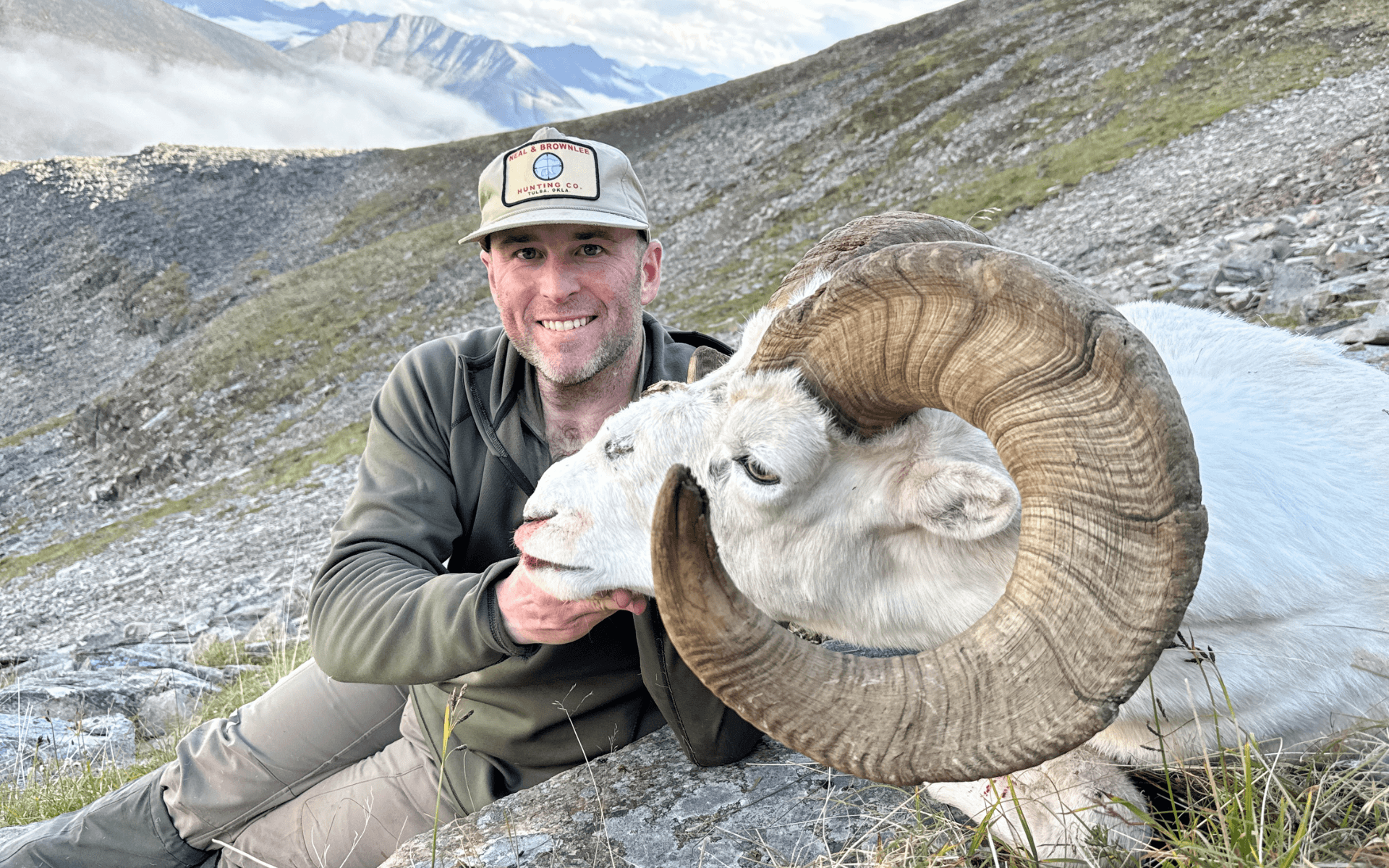
In 2025, my client killed the beautiful Dall ram featured in this article’s main image. The pack-out lasted between 12 and 13 hours.
Heavy Packs – On the Way in and the Way Out
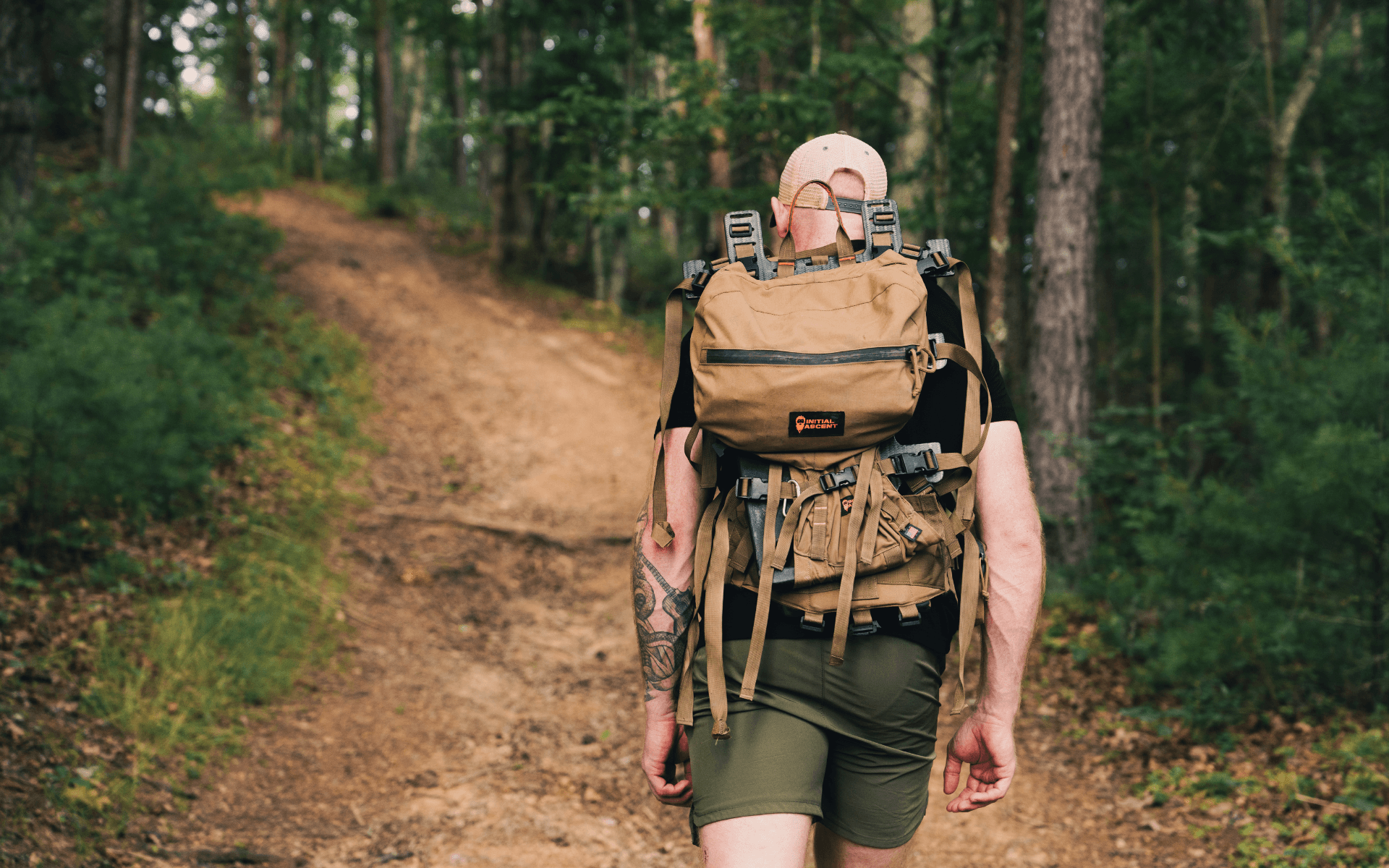
Between camp, food, layers, rifle, ammo, and the rest of your gear, you’re looking at about a 60-pound pack on the way in. If you kill, your pack will easily be around 100 pounds during the pack-out.
You must have the structural integrity, strength, aerobic capacity, and muscular endurance to climb, descend, and traverse with those kinds of loads on your back.
How Fit Do You Need to Be for a Dall Sheep Hunt?
How fit do you need to be for Dall sheep hunting? The short answer – extremely.
Here are the components that build the extreme fitness you need.
Aerobic Endurance
Constant redlining is a death sentence. It drains the fuel from your body and leaves you with no way to replenish it. Without well-developed aerobic capacity, you will frequently redline during climbs. Not only will this suck the fun out of your hunt, it destroys your mental clarity, limits your chances of success, and sets you up to get hurt. Not to mention you’ll be the turd lagging behind everyone else. No one wants to be that guy. Beyond that, your aerobic system is your recovery system. If you don’t build it, you won’t recover between hard climbs or overnight. If you can’t recover, fatigue builds and you’ll be burnt toast by day two or three.
This is why accumulating so much Zone 1 and Zone 2 work is so important. Yes, it feels “easy.” But it’s absolutely critical that you do it. Otherwise, your energy won’t be stable across time, you’ll burn through all your carbs without a way to replenish them, and you’ll be beat up and sucking wind when everyone else is ready to go. It takes a lot of work. You must develop your aerobic system to a serious level. That means being able to work for hours at a time without a significant raise in heart rate.
We’ll talk about how to plan and accumulate this work later in the article.
Uphill Climbing Strength and Muscular Endurance
Sustained. Uphill. Vertical. Hiking…under load.
This is the aspect of Dall sheep hunting fitness that gives hunters butterflies in their stomach and causes sleepless nights for those who know they haven’t done enough preparation.
Now, there’s a part of developing this aspect of your fitness that might surprise you. That’s relative strength. It’s how strong you are relative to your body weight. If you're big, fat and strong, that doesn’t matter much. However, if you’re strong and relatively light, it severely increases your energy efficiency. Each step you take costs you less because each step you take is relatively lower compared to the maximal amount of strength you have.
The next step is transforming your relative strength into strength endurance and muscular endurance.
Strength endurance is the ability to access your strength over time because your nervous system is trained to send strong signals to your muscles through repeated efforts. You have to train it to fight nervous system fatigue.
Muscular endurance is the ability to keep contracting your muscles while fighting off local fatigue. That means your muscles get better at clearing out and recycling the metabolites that signal fatigue. When those metabolites build up during hard work, your muscles can’t contract as hard or as often.
You need serious amounts of strength, strength endurance, and muscular endurance to continually drive yourself uphill with your pack on.
Load Carrying Strength and Efficiency
Think of your body like a truck chassis.
It has to be sturdy enough to haul whatever load you’re carrying without breaking down. And it has to be able to transfer force into the ground to propel you forward. If you do not have a strong and sturdy chassis, and the ability to transfer force into the ground for long periods, you won’t have load carrying efficiency.
So, what builds your chassis?
There are several big things that solidify your chassis – strength, posture, structural integrity, and breathing.
Strength training with good form and with the right lifts supports posture, as does good joint mobility and stability. They combine to create structural integrity. Then good breathing mechanics locks it all in.
Then there’s the continual force transfer through your feet and into the ground that carries you uphill and downhill. This is where your aerobic system, strength endurance, and muscular endurance kick in. When they all work in concert, you can efficiently haul weight without an overwhelming cost to your body.
That’s the goal – minimizing energy expenditure while you haul your ass and your pack through the mountains. And it’s the fundamental definition of load carrying efficiency; maintaining stable energy output while hauling a pack over challenging terrain.
You need a hell of a lot of that efficiency.
(Our Pack Capacity Calculator estimates your current uphill packing efficiency and how much weight you can safely pack uphill right now based on the outcome of our 10-Minute Step-up test. Click HERE to download it for free.)
Downhill Control
It’s like the old saying goes, uphills get your lungs, downhills get your legs. The problem is hunters get so worried about the uphills, that they forget to train for the downhills.
You begin the process by turning your quads into monsters. They take the brunt of the downhill beating, so making them as strong and resilient as possible lays the foundation. Regular front squats, Zercher squats, lunges, and step-ups all help. But it’s also necessary to do some eccentrically-loaded movements. That means accentuating the lowering portion of the lift, which is closer to the stress your quads take while hiking downhill under load. It’s also important to do some fast-drop, hard-catch movements. This replicates the hard contractions that fire your quads during downhills. If you’re a trail runner, this looks like running downhill, or at least jogging downhill, instead of hiking downhill. (I, of course, mean without your pack on.)
You also need a hellishly strong and stable core. Without it, you’re at the will of your pack. It will shift your center of gravity to and fro, knocking you off balance, or at least disproportionately stressing parts of your body. A strong core keeps your pack from bending you over and owning you. Because if your pack bends you over on a downhill, you might be the first one to the bottom. You just won’t like how you get there.
The Three Pillars of Sheep Hunting Preparation
Every solid system is held up by pillars based on sound principles. There are three sheep hunting physical prep principles that you must stand up if you want to walk the big mountains of the Northwest Territories.
Aerobic Conditioning
Pillar 1 is aerobic conditioning.
It is the most important aspect of mountain hunting conditioning. Without a well-developed aerobic system, you will not have the endurance to carry you through a backpack Dall sheep hunt.
Aerobic training breaks into two branches – aerobic capacity and aerobic power.
You build aerobic capacity by doing high volumes of low- to moderate-intensity training in Zones 1 and 2. The easiest way to find the top of your Zone 2 is to subtract your current age from 180. For example, if you’re currently 40 years old, the equation is 180 - 40 = 140 beats per minute. Now, if you’ve never trained, or haven’t been training for months, knock another 5 to 10 beats per minute off that. Sticking with our example, that takes you down to 130 or 135. However, if you’ve been consistent with aerobic work for years, you can add another 5 to 10 beats per minute. Subtract 10% from the top of your Zone 2 and you have the bottom of your Zone 2. In our current example, the bottom of our 40-year-old hunter’s Zone 2 is 124. Subtract another 10%, and you have the bottom of Zone 1. In this case, 110 beats per minute.
(However, the best, practical way to find your Zones 1 and 2 is with aerobic testing. We use two tests with our Packmule Elite clients to lock in on their current aerobic training zones.)
It’s important that you build up to doing long Zone 1 and 2 sessions. I’m talking two to four hours at a single clip. These long sessions make your aerobic system more durable by making it more efficient at producing energy. It also strengthens your cardiorespiratory system. The combination allows you to work for longer without an increase in heart rate. This improves your endurance because it lengthens the time to fatigue, partly by decreasing the amount of fat and carbs necessary to move you up and down slopes. During the process, you’ll also develop your slow-twitch muscle fibers and decrease your body’s overall stress response – to exercise and in general. That’s huge for endurance and for keeping your head on straight while hunting.
You build aerobic power by doing various forms of high-intensity interval training. When you develop aerobic power, your aerobic system generates energy faster and your ability to utilize oxygen is accentuated.
To develop aerobic power, you must spend appropriate amounts of time in Zones 3, 4, and 5. That sometimes means doing some really gnarly shit. This includes moderately hard intervals lasting up to 45 minutes, and very hard intervals lasting up to 5 minutes. The crux of it all comes from the first sentence of this paragraph; the amounts must be appropriate. You don’t need to kill yourself with this stuff. You just need enough to round out your aerobic development. If you do too much too soon, you chance diminishing your aerobic capacity.
And here’s the thing: If your aerobic capacity training isn’t yet where it needs to be, there’s little benefit to adding in aerobic power training. Think of it like paving a road. Aerobic capacity makes the road smooth so you can speed down that puppy. If you don’t pave the road first, not only can you not drive as fast, you’ll beat the hell out of your truck when you try.
Aerobic Conditioning Methods for Sheep Hunting
The meat of your sheep hunting aerobic conditioning is training on an incline while wearing your pack. If you’re lucky enough to live somewhere with long mountain slopes, you can get out into those hills for your aerobic work. However, if you’re a flatlander or you live in a place with only small ridges, you’ll have to make friends with the incline treadmill and stairclimber.
Accruing incline work in Zones 1 and 2 builds the foundation of your sheep hunting endurance. That’s not to say there isn’t room for general aerobic training like jogging, biking, and swimming. Those methods are great for building total aerobic volume, and to add in some variety to keep you from getting burned out by specific conditioning. But it’s important to shift your aerobic volume from more general to more specific as you get closer to your hunt. For example, you should mostly be doing incline work during the final three to four months leading up to your hunt, while potentially adding in shorter sessions of general methods for a little variety.
You want to work up to consistently doing 4+ hours per week of aerobic capacity training, especially during the lead up to the preseason. Then, you don’t need to worry quite as much about heart rate zones as you do simply moving at a sustainable pace.
Once you’re consistently doing three to four hours per week of aerobic capacity training for a couple months, you can add in aerobic power training. I use different methods depending on the client, their specific hunt, and their current conditioning level. It’s often better to use more general methods for aerobic power training. For example, I’ll often use an air bike for lactate threshold (Zone 4) and V02max (Zone 5) intervals. I like the air bike in these instances because it incorporates the whole body while limiting the overall stress on the body and giving hunters a break from pack work. That said, I will program lactate threshold intervals on the stairclimber for some clients. I’ve even had some do V02max intervals on the stairclimber. And I’ll sometimes program running for aerobic power workouts, if the hunter is a skilled runner with a lot of experience. But for most folks most of the time, the airbike is the ticket for high-intensity work.
That’s because we’re looking for more general gains. We’re generally improving how quickly the body clears metabolites and replenishes fuel. We’re generally training the heart to contract harder. We don’t need a pack or an incline for that. We save the packs and the inclines for the more specific, long uphill slogs because those are the instances when we want to keep our heart rates down and move efficiently under our packs.
Mountain Muscular Endurance and Work Capacity
Pillar 2 is Mountain Muscular Endurance and Work Capacity.
Earlier, we generally defined muscular endurance. Mountain muscular endurance means training your muscles to repeatedly contract to drive you uphill and control you downhill.
We split muscular endurance into two buckets – fast-twitch and slow-twitch.
Your body has two types of fast-twitch muscle fibers. They are Type IIx and Type IIa. Type IIx fibers fire at higher thresholds and run on carbs. They aren’t as important for sheep hunting, but they get muscular endurance work when you do Zone 4 and Zone 5 intervals.
Type IIa fibers, however, are very useful to you as a sheep hunter. This is oversimplified, but they’re kind of in between a fast-twitch fiber and a slow-twitch fiber. That means you can develop them aerobically to assist slow-twitch fibers in prolonging your endurance. You can train them by doing work in Zone 3 and by doing a specialized type of strength training called High-Intensity Continuous Training (HICT). I program uphill Zone 3 work and HICT for sheep hunters.
Then there’s slow-twitch muscular endurance. We develop this in a couple of different ways. First, your uphill Zone 2 work is huge for slow-twitch muscular endurance because you move under load and at a pace that keeps your heart rate low enough to stay aerobic. I also program a specialized form of strength training called Tempo Strength Training. This technique keeps muscles under continual tension for 30 to 60 seconds followed by incomplete rest. This deprives your slow-twitch fibers of oxygen, causing them to grow.
In general, work capacity means how much physical work you can do and recover from. Specifically, it means how much uphill and downhill work can you handle. But there’s more to mountain hunting than walking up and down slopes with your pack. There’s also setting up and taking down camp, clearing a spot for camp if necessary, and retrieving water, etc. You need a lot of specific work capacity to thrive during training and the hiking portions of your hunt, but you also need general work capacity to handle everything else. The best thing you can do to increase your work capacity is a lot of aerobic training, strength training, and muscular endurance training – essentially everything I instruct you to do in this article.
Muscular Endurance Methods for Sheep Hunting
We have a few mainstays. I’ll describe the ones mentioned above in more detail.
First up is a dead horse I’ll continue to flog – incline Zone 2 training with a pack. It makes your slow-twitch muscle fibers strong, durable, and fatigue resistant. But you have to keep the intensity in the right place. If you don’t, you’ll slip into fast-twitch fiber land and not get the same training benefit. You progress this by increasing pack weight and incline. More on that later.
Then there’s tempo strength training, which is a great slow-twitch development tool. It’s constant movement with relatively light weight for 30 to 60 seconds with incomplete rest. It’s as miserable as it sounds. You go down for 2 seconds with no pause at the bottom. Then you go up for 2 seconds with no pause at the top. Then you keep going until time’s up. To get the best carryover to the mountain, we use front squats and rear-foot elevated split squats because they accentuate the quads.
We also use steady state intervals, which are also called Zone 3 intervals. For example, you’ll work for 20 minutes in Zone 3, actively rest by slowing down and decreasing your heart rate into Zones 1 and 2 for a few minutes, then ramp back up and do another 20-minute set in Zone 3. Not only is this important for topping off your aerobic system, but it conditions your Type IIa fibers so they’re available when you need them.
HICT tops off our fast-twitch methods. To transfer HICT work to the mountain, we do it while wearing our packs and doing step-ups. Tempo, however, is key. Go too fast and you turn it into an acid bath and miss the benefit. Go too slow or too easy and you just end up recruiting slow-twitch fibers. You have to Goldilocks it. There are different ways to hit the sweet spot, and you’ll do that by using different paces depending on the time of year. For example, in the spring we’ll use a cadence of one intense step-up per leg every 10 to 15 seconds. As we get closer to a hunt, the pace increases to one step-up per leg every 4 to 5 seconds.
Weight and intent are also hugely important during HICT step-ups. The weight must be heavy enough, and your intent must be forceful enough to recruit your Type IIa fibers. You know you’ve chosen the right weight when you can maintain forceful intent without your heart rate climbing only into the middle of your Zone 3. Bonus, this is a great method for heavy pack conditioning. My advanced clients will use up to 40% to 50% of their body weight while doing HICT step-ups. It gives you the opportunity to acclimate to heavy packs without the risk or inefficiency of doing it on a trail.
There’s also a huge aspect of muscular endurance training that’s often overlooked by sheep hunters – high volume calf training. It makes your feet and lower legs resilient while also sustaining your uphill drive. We’ll work up to doing 5-minute sets of alternating single-leg calf raises to build muscular endurance.
Pack Training
Pillar 3 is pack training.
We’ve mentioned pack training for sheep hunting in the previous sections. In this section, I’ll teach you how to progress it.
I’ve used the word “efficiency” a lot in this article. That’s because it’s the name of the game when it comes to mountain hunting. And it’s specifically the name of the game when it comes to pack training.
You build efficiency under load by progressing intensity in an intelligent way. Intensity, in this case, means the weight in your pack and the steepness of the incline you’re walking on. And before you worry too much about intensity, you must concern yourself with volume.
In this context, volume means amount. Pack training is best progressed by accruing a meaningful amount of volume before adding intensity via pack weight or incline. It’s time under your pack with a weight that doesn’t impact your gait that makes the biggest difference – especially in the early going.
Now, I know you’re a sheep hunter. Or, if you’re not yet a sheep hunter but prepping for your first Dall sheep hunt, it’s likely that you’ve hunted other mountain critters, and done so while wearing a pack. I say all of this because I know it’s likely that you have some time under load. And I say that because I’m about to teach you the entire pack training progression, from flat ground to steep inclines. If you’re a beginner, great. You’ll know exactly how to take yourself from start to finish. If you have experience, examine the progression to find your current level and progress from there.
Pack Training Progression: From Flatland to Steep Inclines
To begin, here’s a fact we know about pack training from military and mountaineer research:
You gain the most load carrying efficiency by training with about 20% of your body weight.
This is because it’s the amount of weight that offers enough challenge to build sturdiness and fitness without altering gait, posture, or breathing mechanics.
We also know that spending too much time with 30% of body weight or more in your pack engrains bad habits that lead to inefficiency. This happens because gait, posture, and breathing mechanics are each altered to a significant degree. It also compounds unnecessary joint stress that could lead to pain or injury.
The average American man stands 5’9” and weighs 199 pounds. That makes 40 pounds the appropriate rucking load for most guys. However, those new to pack training shouldn’t just jump into training with that heavy of a load. While we know 20% of body weight does the most needle moving, it’s still necessary for those who’ve never pack trained to work up to it. Otherwise, they run the risk of developing the same bad habits and unnecessary joint stress caused by training with heavier pack loads.
So, if you’re new to pack training, and don’t have a good aerobic base or solid levels of relative strength, start with 10% of body weight. If you’re new but have a solid amount of aerobic training under your belt, and are relatively strong, start with 15%.
And you’ll start on flat ground, doing 2 to 3, 45- to 60-minute sessions per week. Do this for a month, while also consistently strength training, and the weight should start to feel easy. Then go ahead and bump the weight up by 5%. If you started at 10%, keep following that process until 15% is easy, then work up to 20%.
As you ruck on flat ground, you’ll also do Zone 1 and 2 incline hiking sessions. This acclimates your body to inclines and improves your aerobic conditioning before you add weight. Start at about a 10% incline. It might feel painfully slow at first, that’s okay. However, if you feel like you need to run to get your heart rate in Zone 2 at 10% incline, increase the incline to somewhere between 12% and 15% until you can move at a sustained pace while keeping your heart rate in the aerobic zones. (Side note: If you’re a runner and can run on a 10% incline while keeping your heart rate in the aerobic zones, that’s fine.)
Once you’ve accrued a month of rucking at 20% combined with unweighted incline work, it’s time to test your efficiency under load. You’ll do that with our 3-Mile Rucking Assessment.
The 3-Mile Rucking Assessment
Plot a repeatable three-mile course on the flattest available ground. Warm up by doing a fast, unloaded, 15-minute walk. Then, strap on a chest strap heart rate monitor, load 20% of your body weight into your pack, and ruck at your fastest sustainable pace to complete the three miles. Stop your heart rate monitor as soon as you complete the three miles.
If you finish in 45 minutes or less with an average heart rate in Zone 2, you’re ready for incline pack training.
(If you want a full mountain fitness assessment that includes the 3-Mile Rucking Assessment along with mobility, strength, and uphill muscular endurance testing, download The Hunter’s Field Test for free at the following link >>> Free Hunter’s Field Test.)
Incline Pack Training Progression
Start on a 10% incline with 15% of your body weight in your pack. Do 2-3, 60-minute sessions per week until it’s easy to stay in Zone 2 while maintaining a pace of 2-miles-per-hour or faster. This might take a week, it might take a month.
Once you’re there, either increase the incline to 12% or increase your pack weight to 20%, but don’t do both at the same time. If you choose to increase the incline first, stay there until you can maintain a 2-mile-per-hour pace in Zone 2. Then increase your pack weight to 20% of body weight, and stay on the 12% incline until you can maintain a 2-mile-per-hour pace in Zone 2. Once you can do that, increase the incline to 15%.
If you choose to first increase your pack weight to 20% while on a 10% incline, stay there until you can maintain a 2-mile-per-hour pace in Zone 2. Then, increase the incline to 12% until you can maintain the pace in Zone 2. Then, increase the incline to 15%.
Once you’re cruising at a 1.5 to 2-mile-per-hour pace on a 15-degree incline with 20% of your body weight in your pack, you’re ready for steeper work because you are in serious mountain hunting condition. This is an elite level of sheep hunting readiness.
If you have access to a treadmill that inclines beyond 15 degrees, you can stick with the treadmill. However, I know most treadmills top out at 15 degrees, so you’ll likely have to start incorporating the stairclimber.
As you increase the incline, drop your pack weight back down to 10% to 15% to acclimate. Pace at steeper inclines isn’t as predictable and the amount of vertical gain per hour dramatically increases. You won’t be able to maintain a fast pace while staying in Zone 2. The muscular and cardiorespiratory demands are just too high. So, go slow and keep your heart rate down.
Once your pace smooths out, you can increase the load up to 20% of body weight. However, a better strategy is to keep your pack in the 10% to 15% range for your really steep work, while hitting your 20% work at 15 degrees or less. This bookend strategy ensures that you’ll build uphill fitness without giving your body too much stress. One steeper and lighter session combined with a couple heavier sessions at a decreased incline is a solid plan.
There’s another aspect of uphill pack training we have to discuss – long sessions.
Long Session Pack Training Progression
While progressing weight and incline are necessary, you’ll also need to train yourself to be under your pack for hours at a time. That means up to 3 or 4 hours, and a backpacking trip or two if possible.
The best way to progress up to longer sessions is by planning weekend hikes if you have terrain available. If not, you’ll progressively lengthen one of your pack training sessions.
Here’s a simple process for walking a long pack workout up to 3 hours:
Week 1: 60 mins
Week 2: 75 mins
Week 3: 90 mins
Week 4: 75 mins
Week 5: 90 mins
Week 6: 105 mins
Week 7: 90 mins
Week 8: 105 mins
Week 9: 120 mins
Week 10: 135 mins
Week 11: 105 mins
Week 12: 120 mins
Week 13: 135 mins
Week 14: 150 mins
Week 15: 120 mins
Week 16: 150 mins
Week 17: 180 mins
Yes, that’s 17 weeks. Building the work capacity to handle that kind of single-session volume takes time.
You’ll also want to scale back your pack load and the incline until you acclimate to longer durations. For example, you’re likely fine to keep incline the same when increasing from 60 minutes to 75 minutes. But you’ll want to decrease one or the other for that first 90-minute session. You’ll toggle it like that the entire way through the progression until you can ruck in Zone 2 for 3 hours (180 minutes) with 20% of your body weight. If you do it that way, you will make meaningful progress without murdering yourself.
Acclimating to Heavier Packs
Incline work with 20% of your body weight will build the necessary efficiency and endurance under load. However, it is good to do some heavier pack work for acclimation. The key is doing it in a controlled environment to limit your risk of injury and so you don’t give your body too much stress at one time.
We do that in two ways – with HICT step-ups and with short, incline Zone 3 sessions.
HICT step-ups are done with up to 50% of body weight in a pack on a 12” box. I individualize a client’s pack weight based on the results of their 10-Minute Step-up Test. However, I’ll offer you general guidelines. You want a weight that allows you to do each rep forcefully while also keeping your heart rate no higher than low Zone 3 throughout the set. If you’ve accrued some time under your pack, that’s likely going to be more than 20% of your body weight. For most, it will be somewhere between 30% and 40%. That’s perfect for a 200-pound hunter. It puts them somewhere between their pack in weight and the pack out weight if they kill.
Incline Zone 3 sessions work similarly to HICT step-ups, just with less forceful contractions. Hunters can work up to carrying 40% of their body weight in a controlled environment. You can progress from 30-minute sessions up to 45-minute sessions while keeping your heart rate in low Zone 3 the whole time. It’s also important to do an easy, 15-minute, unweighted warm-up on the incline before putting on your pack. This primes your aerobic system to work before training.
These are preseason training methods. You’d do a few of each in the 12 weeks leading up to your hunt.
Example Weekly Training Plan for an NWT Dall Sheep Hunter
This example comes from a preseason training program. It’s very important that you keep that in mind as you peruse it. You wouldn’t jump in with a week like this. You’d build up to this kind of work over the course of months. Also, it is an example, not Gospel. For clients, I’d make individualized decisions based on their testing outcomes and training needs.
Day 1 - Strength Endurance
A1. Repeated Dumbbell Vertical Jumps: 3 x 5 w/ 20% of body weight split between each hand
A2. Ab Wheel Rollouts: 3 x 10
A3. Modified Plyo Pushups: 3 x 5
A4. Cat Cows: 3 x 5
B1. Eustress Style Dumbbell Rear-Foot Elevated Split Squats
20 total minutes. 3 reps each leg. Keep heart rate under 150 at all times, rest until heart rate drops to 160 minus age.
Ex: 3 reps on right leg. Rest until HR hits 160 minus age. 3 reps on left leg. Rest until HR hits 160 minus age. Continue this way until time expires
C1. Eustress Style Double Kettlebell Overhead Press
15 total minutes. 3 reps at a time. Keep heart rate under 150 at all times, rest until heart rate drops to 160 minus age.
Ex: 3 reps. Rest until HR hits 160 minus age. 3 reps. Rest until HR hits 160 minus age. Continue this way until time expires
D1. TRX Inverted Rows: 2 x 15
D2. Stability Ball Hamstring Curls: 2 x 15
Day 2 - Zone 2 Incline Rucking
60 minutes in Zone 2 with 20% body weight in pack on stairclimber
Day 3 - Recovery
Mobility work and an easy walk.
Day 4 - HICT Training
A1. HICT Step-ups w/ 40% of body weight in pack with a 12” box.
1 rep each leg every 5 seconds.
2 x 15 minutes w/ 3 minutes rest between sets
B1. HICT Bent Over Dumbbell Rows
2 reps every 15 seconds
1 x 12 minutes
C1. Dumbbell Bench Press: 3 x 10
C2. Dumbbell RDLs: 3 x 10
Day 5 - Zone 2 Incline Rucking
60 minutes in Zone 2 with 20% body weight in pack on stairclimber
Day 6 - Long Zone 2 Pack Training
150 minutes in Zone 2 with 15% body weight in pack on a 15-degree incline
Day 7 - Recovery
Mobility work and an easy walk.
Common Training Mistakes Sheep Hunters Make
Sheep hunters make a lot of training mistakes. Here are the three I see the most.
Too Much High-Intensity Training
Sheep hunters are sold that they have to murder themselves to be ready to hike mountains. It’s a lie – a very harmful one.
Too much high-intensity training makes recovery all but impossible while not building the actual fitness you need to cover vertical ground every day for 10 to 15 days at a time.
If you’re following a training program that makes every training session feel like survival, and you're sore for days afterwards, stop that program immediately. It’s setting you up for failure.
Accruing volume while training on inclines is the name of the game for sheep hunt preparation. And you can’t accrue enough training volume if you’re constantly training at high intensity.
Starting Too Late
I bet you’ve noticed the length of the training progressions in this article. That’s because mountain hunting fitness takes a lot of work, and it isn’t a test you can cram for. Although, many sheep hunters try to play it that way. They hurry up and try to get ready in a few months. And that leads them to make mistake number one because they believe a lot of high-intensity training will replace months-worth of Zone 1 and Zone 2 work. It doesn’t.
It also doesn’t leave enough time for gaining uphill efficiency under load, building strength, or building muscular endurance. Sheep hunting fitness takes time.
It’s best to give yourself at least a year to prepare, 18 months is even better.
Can you make strides and be in decent sheep hunting shape in less time? Sure. But you won’t have enough time to be fully prepared.
Training with Too Heavy of a Pack
Sheep hunting pack weights scare a lot of hunters. So, they think they need to hammer themselves with unreasonably heavy packs all the time to prepare. All this does is beat the hell out of their bodies while making them inefficient under load. Going heavier is not the solution. Accruing a lot of time under your pack on inclines is.
How to Know if You’re Ready for a Sheep Hunt
Taking our Field Test is a great place to start. You’ll discover if you have enough relative strength, if you’re uphill muscular endurance is on point, and if you’re efficient under load.
Some of the metrics from the workouts in this article also work as great benchmarks. For example, if you can maintain a 1.5 to 2 mile-per-hour pace for an hour on a 15% incline with 20% of your body weight in your pack, your sheep hunting fitness is in a solid place.
However, the best way to know is to follow a proven, and individualized training program like we offer in Packmule Elite. That way you see the progress from week-to-week and month-to-month while getting customized training to prepare you for your specific hunt. It also includes more robust testing protocols than the Field Test, and you get my expert guidance every step of the way.
Final Thoughts: Preparation Creates Earned Opportunities
Joe Paterno said, “The will to win is important. But the will to prepare is vital.” Of course, he was talking about football. But the sentiment applies to you as a sheep hunter. If you don’t prepare as you should, you limit your opportunities to move through sheep country with the conditioning you need. And if you can’t handle mountain country, you likely won’t get in position for a shot.
Don’t head to the Northwest Territories underprepared. Give yourself time. Train with the smart progressions demonstrated in this article. And set yourself up for the opportunity at a great ram.